


Why Work With Non-Ferrous Metals?
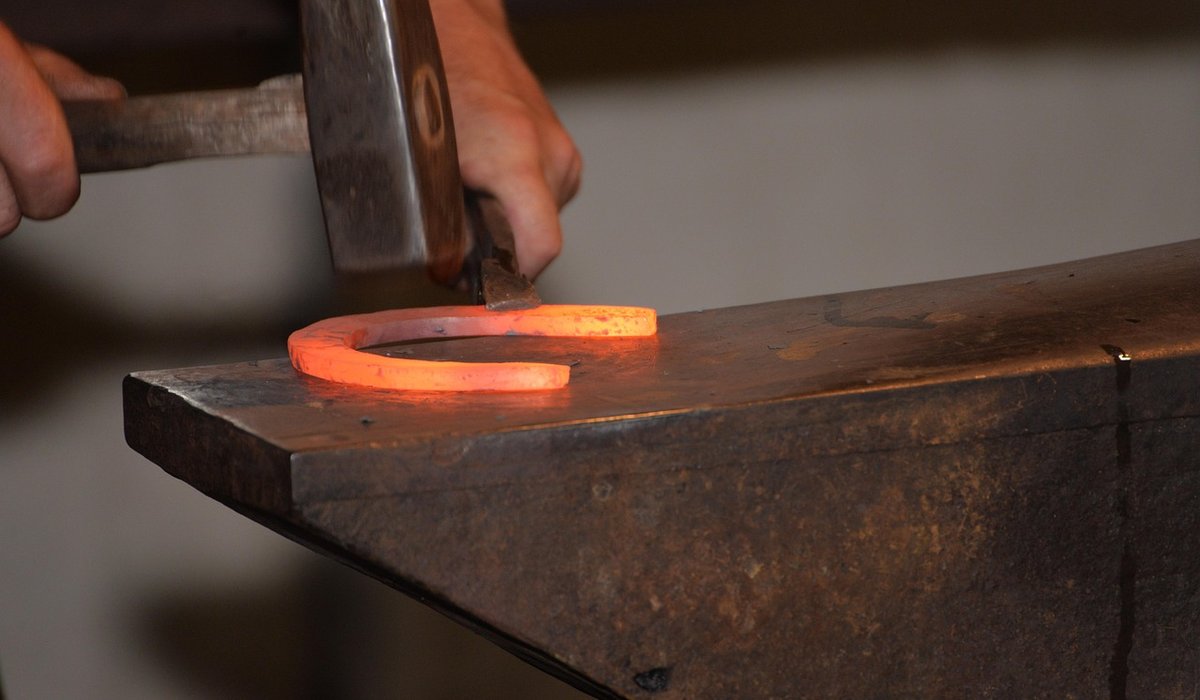
Most of the metal we meet in a blacksmith's shop is ferrous — iron and steel, tough, magnetic, and prone to rust. Step into the jeweller's corner of the workshop, though, and you enter the non-ferrous family: copper, brass, bronze, silver, and their cousins in gold and aluminium. None of them contain iron, so none of them rust, and all of them respond beautifully to hand tools. They cut with a jeweller's saw, move under a hammer, take a mirror polish, and colour up with a patina in a way that steel simply will not.
What follows is a practical introduction for anyone moving from larger metalwork into small-scale jewellery. The principles are the same; the scale and the temperatures are not.
Copper: The Generous Teacher
If you want to learn to saw, file, pierce, and solder, buy copper. It is cheap, widely available in sheet, rod, and tube, and forgiving of beginner mistakes. In its annealed state it is soft enough to bend with your fingers, and it shows you exactly what you are doing.
- Annealing: heat to a dull red, roughly 400–650°C, then quench in water. Copper gives a useful visible clue — a sooty oxide forms that flakes away as the metal reaches temperature.
- Work hardening: it stiffens quickly. A few passes through the rolling mill or a minute of hammering and it needs annealing again.
- Soldering: copper conducts heat away fast, so use a hot, focused flame and work briskly, or the whole piece will sink below soldering temperature.
- Finishing: takes a high polish, but tarnishes to brown within days and turns green against skin. A lacquer or wax coat helps.
Brass and Bronze: Alloys With Attitude
Brass is copper alloyed with zinc; bronze with tin, aluminium, or silicon. Both are harder and warmer in colour than pure copper, and both make handsome jewellery — particularly for hammered bangles, cast pendants, and cold-connected structures.
- Annealing brass: 500–600°C. Unlike steel, it does not harden on quenching, so air cooling or a water quench are both fine.
- The zinc hazard: overheat brass and the zinc boils off as a white oxide fume that is genuinely toxic. An open window is not enough — use extraction, and stop the moment the metal turns a bright orange-yellow.
- Working: brass work hardens faster than copper and cracks at sheet edges if you push it too far. Anneal little and often.
- Bronze: tougher and slower to move, but it takes a deep, rich patina and holds crisp texture well.
Silver: The Jewellery Standard
Sterling silver (925 parts silver to 75 copper) is the alloy you will use most. Fine silver (999) is softer, brighter, and far more resistant to oxidation, which makes it ideal for bezels, granulation, and any surface where you want a clean white finish without fuss.
- Annealing: 650–700°C, judged by a faint dull red in a darkened room. Quench in water immediately.
- Firescale: sterling's copper content oxidises during heating and can sink below the surface, appearing as a grey stain after polishing. Protect the work with a flux coating, use an anti-firescale flux, or switch to fine silver where the surface matters most.
- Pickle discipline: keep a separate pickle pot for copper-bearing metals. A copper-rich pickle will plate a pink blush onto silver in minutes, which is a nuisance to remove.
- Heat conduction: silver is the fastest conductor of any common jewellery metal. Solder with the smallest flame you can get away with, and use tweezers rather than fingers to hold small parts.
Annealing: The Skill Behind Everything
Every non-ferrous metal in the workshop is worked the same way: anneal, form, anneal again. The metal hardens as its crystal structure distorts, and heat lets those crystals regrow. Learn to read the metal rather than the thermometer.
Watch for the moment the surface goes "bright" — a sudden flare of colour as the oxide layer shifts at annealing temperature. Learn to judge by feel: bend a scrap piece; if it fights back, it needs heat. Keep a small pot of water on the bench so you can quench as soon as the colour is right, and always clean and dry the metal before annealing so that dirt does not fuse into the surface.
Finishing Small Work
Finishing is where copper alloys and silver differ most in feel. Both reward a methodical sequence rather than brute force.
- Abrasion: work through wet-and-dry papers from 400 up to 1200 grit, then refine with a fine abrasive such as pumice or a grey polishing compound.
- Polishing: a hard compound such as tripoli for cutting, then rouge or a fine white compound for colour on silver and brass. Keep separate mops for each metal — cross-contamination scratches.
- Burnishing: a polished steel burnisher brings up a hard, bright sheen on bezels and edges without any abrasive at all.
- Patination: liver of sulphur gives copper and silver a range of browns through blues; ammonia fuming turns brass a deep green-gold. Seal afterwards with microcrystalline wax.
Start with copper, graduate to brass, and let silver teach you precision. Each metal has its own temperament, and each one will tell you, quite literally, when it has had enough heat.


Leave a reply